 ailia Tech BLOG
Recent Trends in Transformer Quantization
Transformers are known to be networks that are difficult to quantize. In this article, we will introduce the latest trends in Transformer quantization.
Overview
The Transformer is a deep neural network (DNN) model that uses attention mechanisms. It was introduced in the 2017 paper “Attention Is All You Need.” Initially, Transformers were applied in the field of natural language processing, but they have since become widely used in image and audio fields as well, with models like Vision Transformer and EnCodec. Transformers can uniformly treat language, images, and audio as tokens, forming the foundation for today’s multimodal AI.
Transformer Quantization
Transformers are known to be networks that are difficult to quantize. Among the components of the Transformer architecture, the most computationally intensive part is the Attention mechanism, which is represented as Value * Key * Query. This involves taking the dot product of the Query and Key, and multiplying it by the Value, enabling differentiable table lookup. While the Attention mechanism itself can maintain accuracy even when quantized to Int8, the non-linear operations such as Norm, Softmax, and GeLU are known to be less resilient to quantization.
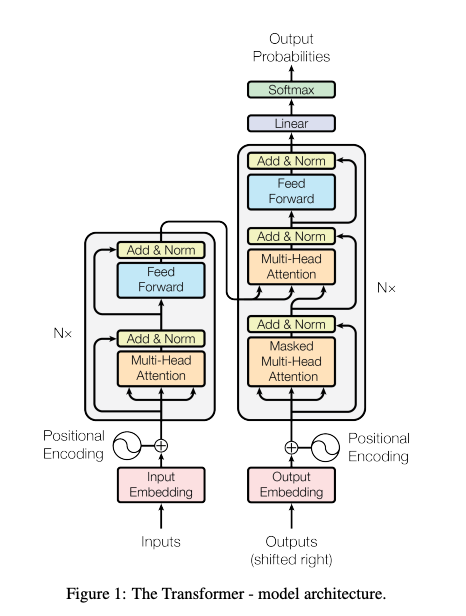
Transformer architecture (Source: https://arxiv.org/pdf/1706.03762)
Faster Transformer Example from NVIDIA
The following is an example of the implementation of Vision Transformer using NVIDIA’s Faster Transformer, a high-speed implementation of Transformers. In this implementation, the Gemm operation, which is the matrix multiplication in the Attention mechanism, is implemented with Int8 precision. However, the Softmax, LayerNorm, and activation functions are implemented with Float precision. The quantization from Float to Int8 (Quant)is referred to as “Q,” and the dequantization from Int8 to Float (deQuant) is referred to as “DQ”
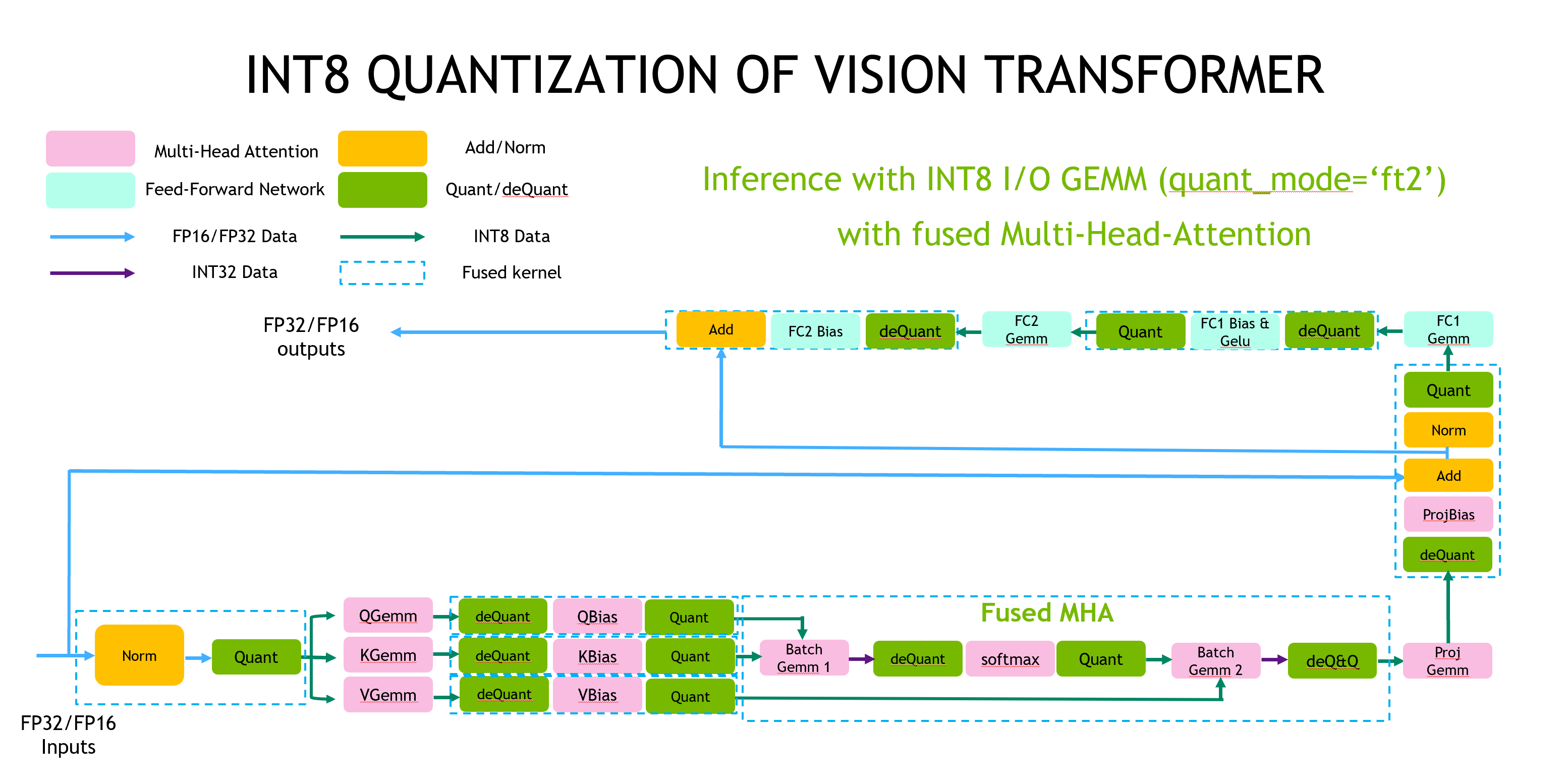
Source: https://github.com/NVIDIA/FasterTransformer/blob/main/docs/vit_guide.md
In the implementation of FasterTransformer, using INT8 GEMM results in an approximate 2.15% degradation in accuracy.

Source: https://github.com/NVIDIA/FasterTransformer/blob/main/docs/vit_guide.md
However, employing INT8 GEMM speeds up inference time on the T4 GPU by 1.67 times.
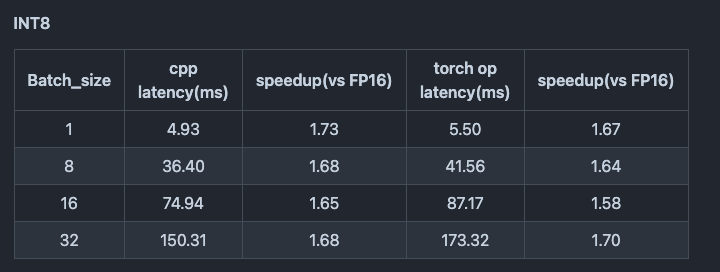
Source: https://github.com/NVIDIA/FasterTransformer/blob/main/docs/vit_guide.md
There has also been a proposal for I-ViT, which implements Softmax, Layer Norm, and activation with integer precision. Although it doesn’t use Int8, butInt32, resulting in a mixed precision approach.
Using FP8 instead of INT8
In recent years, with the introduction of NVIDIA’s H100, FP8 has garnered attention.
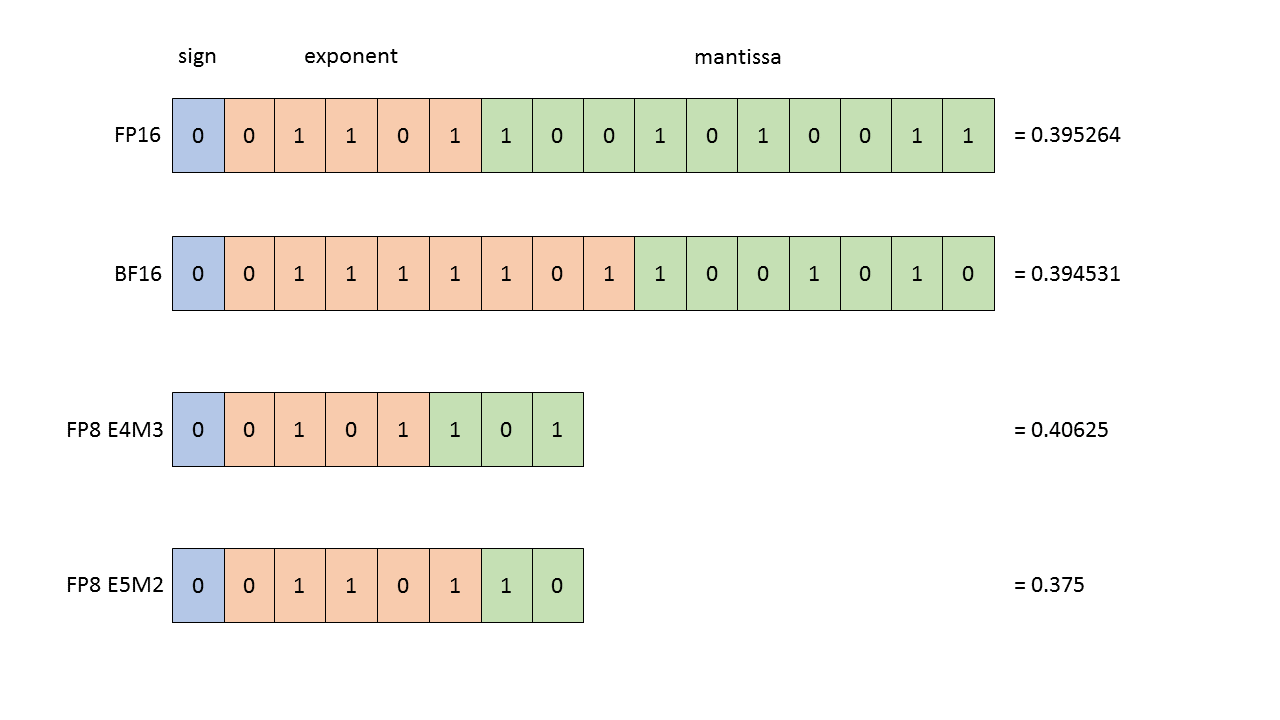
FP8 format (Source: https://docs.nvidia.com/deeplearning/transformer-engine/user-guide/examples/fp8_primer.html)
FP8 has a unique characteristic of non-linear quantization, where it offers finer granularity for smaller values and coarser granularity for larger values, compared to INT8.
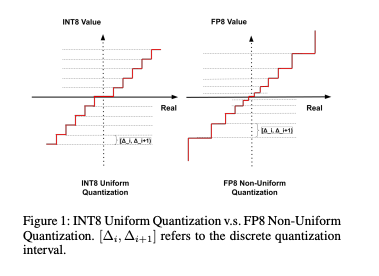
FP8 range (Source: https://arxiv.org/pdf/2312.05725v2)
Below is a usage example of FP8 with BERT.
Using FP8 significantly improves the computational accuracy of BERT models.
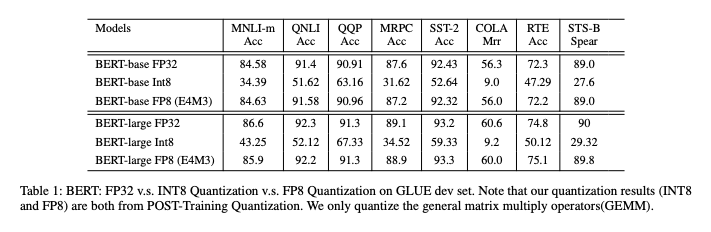
Precision using FP8 (Source: https://arxiv.org/pdf/2312.05725v2)
However, the same paper mentions that non-linear operators like Softmax and GeLU are sensitive to quantization. Therefore, even when using FP8, Softmax and GeLU are executed in BF16 to maintain accuracy.
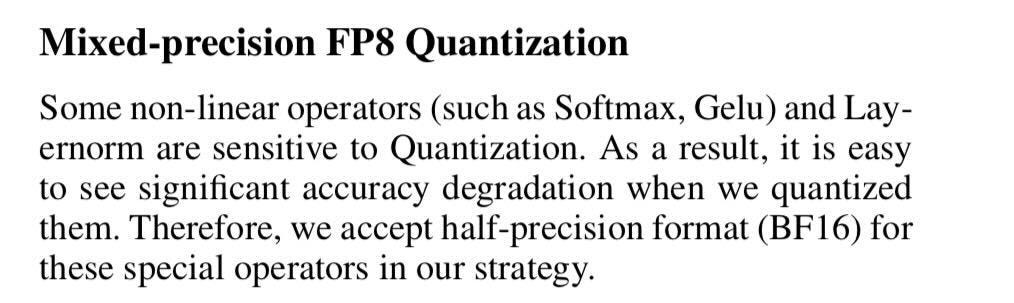
Source: https://arxiv.org/pdf/2312.05725v2
Example of 4-bit Quantization in llama.cpp
Large Language Models (LLMs) use the Transformer architecture. In llama.cpp, an inference runtime for LLMs, 4-bit quantization is widely employed.
The quantization format in llama.cpp is as follows:
Q4_0 : legacy
Q4_1 : legacy
Q4_K_S : Small-Scale Model Using k-quant: All Tensors Quantized to 4-bit
Q4_K_M : Medium-Scale Model Using k-quant: Half of the Tensors Quantized to 4-bit, the Rest to 6-bit
IQ4_NL : 4.50-bit Non-linear Quantization Using Importance Matrices
IQ4_XS  : 4.25-bit Non-linear Quantization Using Importance Matrices
Q4_K_M is recommended, with the formats without “K” being the old format and those with “K” being the new quantization format. Additionally, IQ4_XS uses calibration data with importance matrices, which can potentially enhance performance. However, if calibration is done in English for a Japanese language model, the performance may decrease for inference in Japanese.
In llama.cpp, weight quantization is used, and due to non-linear quantization, the 4-bit weights are expanded to FP16 for GEMM calculations. Therefore, tensors are implemented in FP16.
Below is the GEMM implementation in llama.cpp. It uses cublas and FP16 implementation.
cublasGemmBatchedEx(ctx.cublas_handle(), CUBLAS_OP_T, CUBLAS_OP_N,
                ne01, ne11, ne10,
                alpha, (const void **) (ptrs_src.get() + 0*ne23), CUDA_R_16F,   nb01/nb00,
                       (const void **) (ptrs_src.get() + 1*ne23), CUDA_R_16F,   nb11/nb10,
                beta,  (      void **) (ptrs_dst.get() + 0*ne23), cu_data_type, ne01,
                ne23,
                cu_compute_type,
                CUBLAS_GEMM_DEFAULT_TENSOR_OP));
Trends for NPUs
As mentioned above, achieving high accuracy with Transformers has led to a trend of using mixed precision with FP16 and Int8. Consequently, many recent NPUs are increasingly supporting FP16 operations in addition to Int8.
Below is an example implementation of running Whisper on the RK3588, a SoC by Rockchip. In this implementation, activations are handled using Arm v8’s FP16 instructions, while the Attention mechanism is implemented using the NPU’s FP16 GEMM.
Trends for ONNX
ONNX includes Q and DQ operations, supporting mixed precision. Using the nodes_to_quantize option in the ONNX Runtime quantization tool, you can quantize only the GEMM operations to Int8.
nodes_to_quantize:
                List of nodes names to quantize. When this list is not None only the nodes in this list
                are quantized.
Conclusion
Current Transformer quantization implementations predominantly use a mixed precision approach combining Int8 and BF16. Additionally, both NPUs and frameworks are increasingly designed with mixed precision in mind.
ailia Inc. has developed ailia SDK, which enables cross-platform, GPU-based rapid inference.
ailia Inc. provides a wide range of services from consulting and model creation, to the development of AI-based applications and SDKs. Feel free to contact us for any inquiry.