 ailia Tech BLOG
Quantization with AI Edge Torch
AI Edge Torch (ai-edge-torch pip package) is a library that lets you convert PyTorch models into a .tflite format, enabling you to run those models completely on-device using Tensorflow Lite, or our ailia TFLite Runtime if the official Tensorflow Lite is not supported.
We already introduced AI Edge Torch in the article below.
Now let’s focus on quantization.
In ai-edge-torch, the Torch graph is quantized using pt2e and then converted to TFLite. This article provides a detailed explanation of how quantization is applied to the Torch graph and how it is reflected in the TFLite parameters.
ai-edge-torch (Source: https://developers.googleblog.com/ja/ai-edge-torch-high-performance-inference-of-pytorch-models-on-mobile-devices/)
Conversion pipeline
Below is an example script for creating a quantized model in ai-edge-torch. A model for quantization is created using prepare_pt2e, inference is performed with calibration data, a quantized model is generated using convert_pt2e, converted to TFLite with convert, and saved with export.
quantizer = pt2e_quantizer.PT2EQuantizer().set_global(
    pt2e_quantizer.get_symmetric_quantization_config()
)
model = quantize_pt2e.prepare_pt2e(model, quantizer)
model(torch.from_numpy(img)) # calibration
model = quantize_pt2e.convert_pt2e(model, fold_quantize=False)
with_quantizer = ai_edge_torch.convert(
    model,
    sample_inputs,
    quant_config=quant_config.QuantConfig(pt2e_quantizer=quantizer),
)
with_quantizer.export("resnet18_int8.tflite")
When running prepare_pt2e, astatic graph is created from Torch’s dynamic graph, calibration is performed on this static graph, then a quantized model is generated with convert_pt2e, and a device model is produced through lowering.
The lowering process refers to transforming a high-level model representation (typically annotated with quantization specs) into a lower-level Intermediate Representation (IR) with explicit quantization operations (Quantize / Dequantize) suitable for deployment on edge devices.
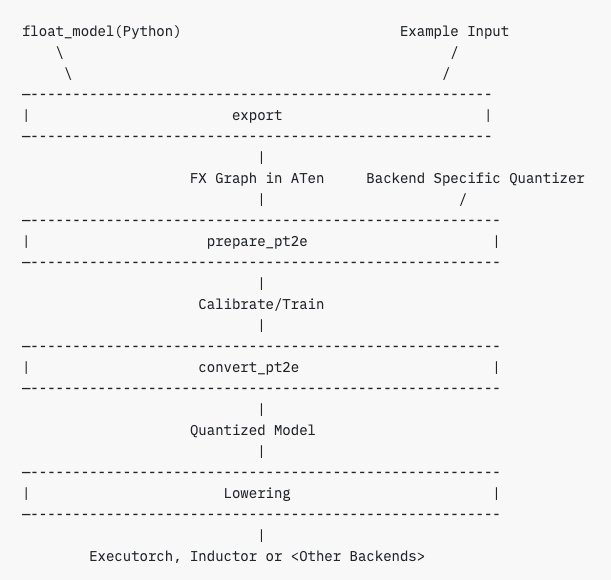
pt2e flow (Source: https://pytorch.org/tutorials/prototype/pt2e_quant_ptq.html)
When you run prepare_pt2e on a Torch graph, an FX graph (static graph) annotated with a QuantizationSpec is generated. Although Torch is characterized by its dynamic computation graphs, by using Torch FX, the dynamic graph can be traced and converted into a static graph.
By running inference on the FX graph with calibration data, calibration information such as Min/Max values and histograms for each tensor is generated based on the QuantizationSpec and annotations set in prepare_pt2e.
When pt2e_convert is called, the FX graph is converted into an Exported Program format. The Exported Program is an intermediate representation as shown below.
ExportedProgram:
    class GraphModule(torch.nn.Module):
        def forward(self, p_mask_downsampler_encoder_0_weight: "f32[4, 1, 3, 3]", p_mask_downsampler_encoder_0_bias: "f32[4]", p_mask_downsampler_encoder_1_weight: "f32[4]", p_mask_downsampler_encoder_1_bias: "f32[4]", p_mask_downsampler_encoder_3_weight: "f32[16, 4, 3, 3]", p_mask_downsampler_encoder_3_bias: "f32[16]", p_mask_downsampler_encoder_4_weight: "f32[16]", p_mask_downsampler_encoder_4_bias: "f32[16]", p_mask_downsampler_encoder_6_weight: "f32[64, 16, 3, 3]", p_mask_downsampler_encoder_6_bias: "f32[64]", p_mask_downsampler_encoder_7_weight: "f32[64]", p_mask_downsampler_encoder_7_bias: "f32[64]", p_mask_downsampler_encoder_9_weight: "f32[256, 64, 3, 3]", p_mask_downsampler_encoder_9_bias: "f32[256]", p_mask_downsampler_encoder_10_weight: "f32[256]", p_mask_downsampler_encoder_10_bias: "f32[256]", p_mask_downsampler_encoder_12_weight: "f32[256, 256, 1, 1]", p_mask_downsampler_encoder_12_bias: "f32[256]", p_pix_feat_proj_weight: "f32[256, 256, 1, 1]", p_pix_feat_proj_bias: "f32[256]", p_fuser_layers_0_dwconv_weight: "f32[256, 1, 7, 7]", p_fuser_layers_0_dwconv_bias: "f32[256]", p_fuser_layers_0_norm_weight: "f32[256]", p_fuser_layers_0_norm_bias: "f32[256]", p_fuser_layers_0_pwconv1_weight: "f32[1024, 256]", p_fuser_layers_0_pwconv1_bias: "f32[1024]", p_fuser_layers_0_pwconv2_weight: "f32[256, 1024]", p_fuser_layers_0_pwconv2_bias: "f32[256]", p_fuser_layers_0_gamma: "f32[256]", p_fuser_layers_1_dwconv_weight: "f32[256, 1, 7, 7]", p_fuser_layers_1_dwconv_bias: "f32[256]", p_fuser_layers_1_norm_weight: "f32[256]", p_fuser_layers_1_norm_bias: "f32[256]", p_fuser_layers_1_pwconv1_weight: "f32[1024, 256]", p_fuser_layers_1_pwconv1_bias: "f32[1024]", p_fuser_layers_1_pwconv2_weight: "f32[256, 1024]", p_fuser_layers_1_pwconv2_bias: "f32[256]", p_fuser_layers_1_gamma: "f32[256]", p_out_proj_weight: "f32[64, 256, 1, 1]", p_out_proj_bias: "f32[64]", b_getattr_l__self_____encoder___0___scale_0__: "f32[4]", b_getattr_l__self_____encoder___0___zero_point_0__: "i64[4]", b__tensor_constant_0: "f32[]", b_getattr_l__self_____encoder___3___scale_0__: "f32[16]", b_getattr_l__self_____encoder___3___zero_point_0__: "i64[16]", b__tensor_constant_1: "f32[]", b_getattr_l__self_____encoder___6___scale_0__: "f32[64]", b_getattr_l__self_____encoder___6___zero_point_0__: "i64[64]", b__tensor_constant_2: "f32[]", b_getattr_l__self_____encoder___9___scale_0__: "f32[256]", b_getattr_l__self_____encoder___9___zero_point_0__: "i64[256]", b__tensor_constant_3: "f32[]", b_getattr_l__self_____encoder___12___scale_0__: "f32[256]", b_getattr_l__self_____encoder___12___zero_point_0__: "i64[256]", b_pix_feat_proj_scale_0: "f32[256]", b_pix_feat_proj_zero_point_0: "i64[256]", b_dwconv_scale_0: "f32[256]", b_dwconv_zero_point_0: "i64[256]", b__tensor_constant_4: "f32[]", b_pwconv1_scale_0: "f32[1024]", b_pwconv1_zero_point_0: "i64[1024]", b_pwconv2_scale_0: "f32[256]", b_pwconv2_zero_point_0: "i64[256]", b_dwconv_scale_1: "f32[256]", b_dwconv_zero_point_1: "i64[256]", b__tensor_constant_5: "f32[]", b_pwconv1_scale_1: "f32[1024]", b_pwconv1_zero_point_1: "i64[1024]", b_pwconv2_scale_1: "f32[256]", b_pwconv2_zero_point_1: "i64[256]", b_out_proj_scale_0: "f32[64]", b_out_proj_zero_point_0: "i64[64]", b__tensor_constant_6: "f32[]", b__tensor_constant_7: "f32[]", b__tensor_constant_8: "f32[]", b__tensor_constant_9: "f32[]", b__tensor_constant0: "f32[32]", pix_feat: "f32[1, 256, 32, 32]", masks: "f32[1, 1, 512, 512]"):
            # File: <eval_with_key>.110:8 in forward, code: quantize_per_tensor_default = torch.ops.quantized_decomposed.quantize_per_tensor.default(arg1_1, 0.07839307934045792, 0, -128, 127, torch.int8);  arg1_1 = None
            quantize_per_tensor: "i8[1, 1, 512, 512]" = torch.ops.quantized_decomposed.quantize_per_tensor.default(masks, 0.07839307934045792, 0, -128, 127, torch.int8);  masks = None

            # File: /sam2/modeling/memory_encoder.py:58 in forward, code: return self.encoder(x)
            dequantize_per_tensor: "f32[1, 1, 512, 512]" = torch.ops.quantized_decomposed.dequantize_per_tensor.default(quantize_per_tensor, 0.07839307934045792, 0, -128, 127, torch.int8);  quantize_per_tensor = None
...
When convert is called, the Exported Program format is converted into StableHLO format using torch_xla. StableHLO is an intermediate representation developed by Google, representing High Level Operations (HLO). Next, the StableHLO format is converted into MLIR, then into TFLite, and finally a TFLiteModel instance is returned.
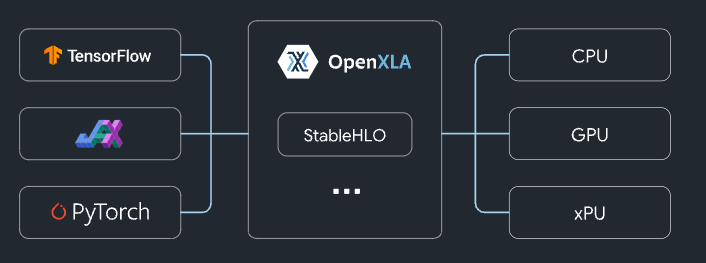
StableHLO overview (Source: https://github.com/openxla/stablehlo)
Exported Program, StableHLO, and MLIR are all intermediate representations, while TFLite is the lowered model, and they are converted equivalently. Therefore, in theory, the quantization accuracy is determined at the initialpt2e stage.
About pt2e
In AI Edge Torch, quantization is performed using pt2e (PyTorch 2 Export), which is the second-generation model exporter in PyTorch. To support various devices, it allows flexible modification of quantization methods from scripts, adapting to device constraints.

pt2e (Source: https://pytorch.org/tutorials/prototype/pt2e_quantizer.html)
For example, on certain devices, the zero_point of an Int8 tensor must be fixed at 0, or asymmetric quantization may not be supported, requiring the use of symmetric quantization instead.
With pt2e, by appropriately describing these constraints in scripts as a QuantizationConfig, quantization can be performed in a format that meets the device requirements.
In pt2e, constraints are specified using QuantizationSpec and Annotations.
QuantizationSpec defines the constraints applied to tensors, such as restrictions on zero_point or the quantization method to be used.
act_quantization_spec = QuantizationSpec(
    dtype=torch.int8,
    quant_min=-128,
    quant_max=127,
    qscheme=torch.per_tensor_affine,
    is_dynamic=False,
    observer_or_fake_quant_ctr=HistogramObserver.with_args(eps=2**-12),
)
There are also special versions of QuantizationSpec, such as SharedQuantizationSpec, which imposes the constraint that input and output quantization parameters must match (e.g. for operations like AveragePooling or Concat), and DerivedQuantizationSpec, which imposes constraints like setting the bias scale in a Conv operation as the product of the input and weight scales.
Annotations are constraints applied to nodes (operators), where QuantizationSpec is assigned to input and output tensors for each node, such as Conv.
input_qspec_map = {}
input_act0 = add_node.args[0]
input_qspec_map[input_act0] = input_act_qspec

input_act1 = add_node.args[1]
input_qspec_map[input_act1] = input_act_qspec

add_node.meta["quantization_annotation"] = QuantizationAnnotation(
    input_qspec_map=input_qspec_map,
    output_qspec=output_act_qspec,
    _annotated=True,
)
Annotations are applied through pattern matching, and quantization is applied to the nodes that match the pattern. Nodes that are not annotated remain in float.
add_partitions = get_source_partitions(gm.graph, [operator.add, torch.add])
add_partitions = list(itertools.chain(*add_partitions.values()))
for add_partition in add_partitions:
    add_node = add_partition.output_nodes[0]
    # Setting quantization_annotation for add_node
Annotations in AI Edge Torch
Node-specific snnotations are defined using the following code. In this example, when a node’s operator matches torch.ops.aten.conv2d.default, constraints are applied via QuantizationSpec to input and output tensors, as well as to weights and bias. As a result of the annotation, the lowered internal representation includes Q (Quantize) and DQ (Dequantize) nodes.
@register_annotator("conv")
def _annotate_conv(
    gm: torch.fx.GraphModule,
    quantization_config: Optional[QuantizationConfig],
    filter_fn: Optional[Callable[[Node], bool]] = None,
) -> Optional[List[List[Node]]]:
  annotated_partitions = []
  for n in gm.graph.nodes:
    if n.op != "call_function" or n.target not in [
        torch.ops.aten.conv1d.default,
        torch.ops.aten.conv2d.default,
        torch.ops.aten.convolution.default,
    ]:
      continue
    conv_node = n

    input_qspec_map = {}
    input_act = conv_node.args[0]
    assert isinstance(input_act, Node)
    input_qspec_map[input_act] = get_input_act_qspec(quantization_config)

    weight = conv_node.args[1]
    assert isinstance(weight, Node)
    input_qspec_map[weight] = get_weight_qspec(quantization_config)

    # adding weight node to the partition as well
    partition = [conv_node, conv_node.args[1]]

    bias = conv_node.args[2] if len(conv_node.args) > 2 else None
    if isinstance(bias, Node):
      input_qspec_map[bias] = get_bias_qspec(quantization_config)
      partition.append(bias)

    if _is_annotated(partition):
      continue

    if filter_fn and any(not filter_fn(n) for n in partition):
      continue

    conv_node.meta["quantization_annotation"] = QuantizationAnnotation(
        input_qspec_map=input_qspec_map,
        output_qspec=get_output_act_qspec(quantization_config),
        _annotated=True,
    )
    _mark_nodes_as_annotated(partition)
    annotated_partitions.append(partition)
  return annotated_partitions
In FX graph nodes, the operator of the node is stored in target, and the inputs to the node are stored in args.
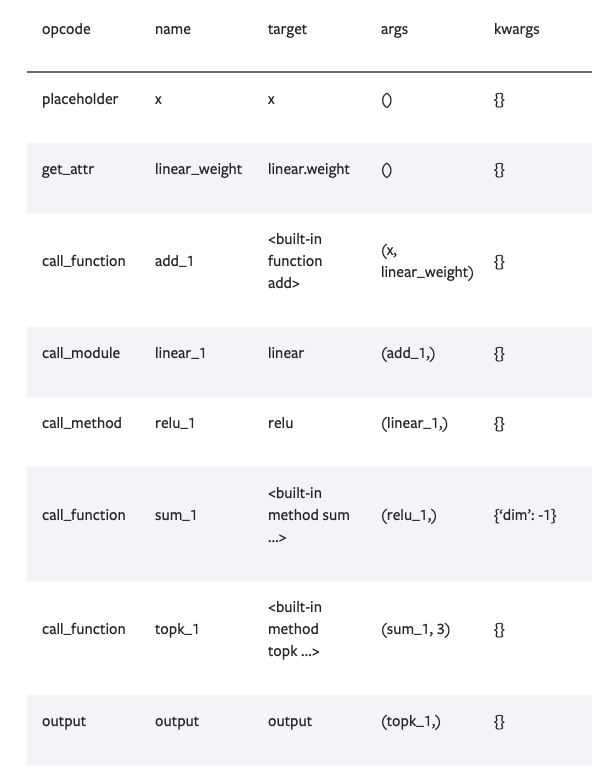
Source: https://pytorch.org/docs/stable/fx.html
Annotations are executed within the annotate function of the PT2EQuantizer, which is passed as an argument to prepare_pt2e. Therefore, it is possible to reference the annotations after prepare_pt2e has been called.
def annotate(self, model: torch.fx.GraphModule) -> torch.fx.GraphModule:
    """just handling global spec for now"""
    if self.global_config and not self.global_config.input_activation:  # type: ignore[union-attr]
      model = self._annotate_for_dynamic_quantization_config(model)
    else:
      model = self._annotate_for_static_quantization_config(model)
    propagate_annotation(model)
    return model

  def _annotate_all_static_patterns(
      self,
      model: torch.fx.GraphModule,
      quantization_config: Optional[QuantizationConfig],
      filter_fn: Optional[Callable[[Node], bool]] = None,
  ) -> torch.fx.GraphModule:
    if quantization_config is None:
      return model

    if quantization_config.is_qat:
      for op in self.STATIC_QAT_ONLY_OPS:
        OP_TO_ANNOTATOR[op](model, quantization_config, filter_fn)
    for op in self.STATIC_OPS:
      OP_TO_ANNOTATOR[op](model, quantization_config, filter_fn)
    return model
Lowering process in AI Edge Torch
As mentioned earlier, the lowering process converts the internal representation into a device-specific model format. In AI Edge Torch, when convert is called, the following code converts the Exported Program into StableHLO, and then into MLIR, which is the internal representation used by TensorFlow.
def exported_program_to_mlir(
    exported_program: torch.export.ExportedProgram,
    sample_args: tuple[torch.Tensor],
) -> stablehlo.StableHLOModelBundle:
  # Setting export_weights to False here so that pytorch/xla avoids copying the
  # weights to a numpy array which would lead to memory bloat. This means that
  # the state_dict in the returned bundle is going to be empty.
  return stablehlo.exported_program_to_stablehlo(
      exported_program,
      stablehlo.StableHLOExportOptions(
          override_tracing_arguments=sample_args, export_weights=False
      ),
  )._bundle
The return value of a quantized model is a TfLiteModel. Since the Exported Program format cannot be used for inference, returning a TfLiteModel enables the model to be executed for inference.
exported_programs = list(map(_run_convert_passes, exported_programs))
  tflite_model = lowertools.exported_programs_to_tflite(
      exported_programs,
      signatures,
      quant_config=quant_config,
      _tfl_converter_flags=_tfl_converter_flags,
      _saved_model_dir=_saved_model_dir,
  )

  return model.TfLiteModel(tflite_model)
Graph optimization
Graph optimization is performed at the FX graph stage before it is converted to StableHLO when convert is called. Before calling lowertools, _run_convert_passes is invoked, and the following optimizations are executed.
passes = [
      fx_passes.BuildInterpolateCompositePass(),
      fx_passes.CanonicalizePass(),
      fx_passes.OptimizeLayoutTransposesPass(),
      fx_passes.CanonicalizePass(),
      fx_passes.BuildAtenCompositePass(),
      fx_passes.CanonicalizePass(),
      fx_passes.RemoveNonUserOutputsPass(),
      fx_passes.CanonicalizePass(),
  ]

  # Debuginfo is not injected automatically by odml_torch. Only inject
  # debuginfo via fx pass when using torch_xla.
  if ai_edge_torch.config.use_torch_xla:
    passes += [
        fx_passes.InjectMlirDebuginfoPass(),
        fx_passes.CanonicalizePass(),
    ]
In the OptimizerLayoutTransposesPass, each node is evaluated to determine whether NHWC layout is required, using either the GREEDY or MINCUT algorithm. If necessary, Transpose operations are inserted. In the case of MINCUT, when a single tensor is referenced by multiple nodes, Transpose operations are inserted at more optimal positions. By default, the algorithm is set to MINCUT, and the operation mode can be configured via the AIEDGETORCH_LAYOUT_OPTIMIZE_PARTITIONER environment variable.
AI Edge Torch practical use cases
Change the quantization settings for specific layers
By calling the annotate function of PT2EQuantizer defined in ai-edge-torch, an annotation is set in n.meta["quantization_annotation"] of the FX graph. By modifying the input_qspec_map of this annotation, it is possible to prevent specific layers from being quantized.
Below is an example of creating a PT2EQuantizer2 class that inherits from PT2EQuantizer. The annotate function is overridden, and when the node is a Conv2D, a float QuantizationSpec is created and set to the input nodes of the quantization_annotation.
class PT2EQuantizer2(pt2e_quantizer.PT2EQuantizer):
    def annotate(self, model: torch.fx.GraphModule) -> torch.fx.GraphModule:
        super().annotate(model)
        for n in model.graph.nodes:
            if n.target in [torch.ops.aten.conv2d.default]:
                if "quantization_annotation" in n.meta:
                    print(n.target)
                    print("Before")
                    print(n.meta["quantization_annotation"])

                    from torch.ao.quantization.quantizer import QuantizationSpec
                    from torch.ao.quantization.observer import PlaceholderObserver
                    act_observer_or_fake_quant_ctr = PlaceholderObserver

                    float_spec = QuantizationSpec(dtype=torch.float32,
                        observer_or_fake_quant_ctr=act_observer_or_fake_quant_ctr.with_args(
                        eps=2**-12
                    ),)

                    for key in n.meta["quantization_annotation"].input_qspec_map:
                        n.meta["quantization_annotation"].input_qspec_map[key] = float_spec

                    #n.meta["quantization_annotation"].output_qspec = float_spec

                    print("After")
                    print(n.meta["quantization_annotation"])
        return model

quantizer = PT2EQuantizer2().set_global(
    pt2e_quantizer.get_symmetric_quantization_config()
)
Here is the QuantizationAnnotation before and after the change to Conv2D.
aten.conv2d.default
Before
QuantizationAnnotation(input_qspec_map={arg1_1: QuantizationSpec(dtype=torch.int8, observer_or_fake_quant_ctr=functools.partial(<class 'torch.ao.quantization.observer.HistogramObserver'>, eps=0.000244140625){}, quant_min=-128, quant_max=127, qscheme=torch.per_tensor_affine, ch_axis=None, is_dynamic=False), _param_constant0: QuantizationSpec(dtype=torch.int8, observer_or_fake_quant_ctr=functools.partial(<class 'torch.ao.quantization.observer.PerChannelMinMaxObserver'>, eps=0.000244140625){}, quant_min=-127, quant_max=127, qscheme=torch.per_channel_symmetric, ch_axis=0, is_dynamic=False), _param_constant1: None}, output_qspec=QuantizationSpec(dtype=torch.int8, observer_or_fake_quant_ctr=functools.partial(<class 'torch.ao.quantization.observer.HistogramObserver'>, eps=0.000244140625){}, quant_min=-128, quant_max=127, qscheme=torch.per_tensor_affine, ch_axis=None, is_dynamic=False), allow_implicit_sharing=True, _annotated=True)
After
QuantizationAnnotation(input_qspec_map={arg1_1: QuantizationSpec(dtype=torch.float32, observer_or_fake_quant_ctr=functools.partial(<class 'torch.ao.quantization.observer.PlaceholderObserver'>, eps=0.000244140625){}, quant_min=None, quant_max=None, qscheme=None, ch_axis=None, is_dynamic=False), _param_constant0: QuantizationSpec(dtype=torch.float32, observer_or_fake_quant_ctr=functools.partial(<class 'torch.ao.quantization.observer.PlaceholderObserver'>, eps=0.000244140625){}, quant_min=None, quant_max=None, qscheme=None, ch_axis=None, is_dynamic=False), _param_constant1: QuantizationSpec(dtype=torch.float32, observer_or_fake_quant_ctr=functools.partial(<class 'torch.ao.quantization.observer.PlaceholderObserver'>, eps=0.000244140625){}, quant_min=None, quant_max=None, qscheme=None, ch_axis=None, is_dynamic=False)}, output_qspec=QuantizationSpec(dtype=torch.int8, observer_or_fake_quant_ctr=functools.partial(<class 'torch.ao.quantization.observer.HistogramObserver'>, eps=0.000244140625){}, quant_min=-128, quant_max=127, qscheme=torch.per_tensor_affine, ch_axis=None, is_dynamic=False), allow_implicit_sharing=True, _annotated=True)
Normally, Conv is output in Int8.
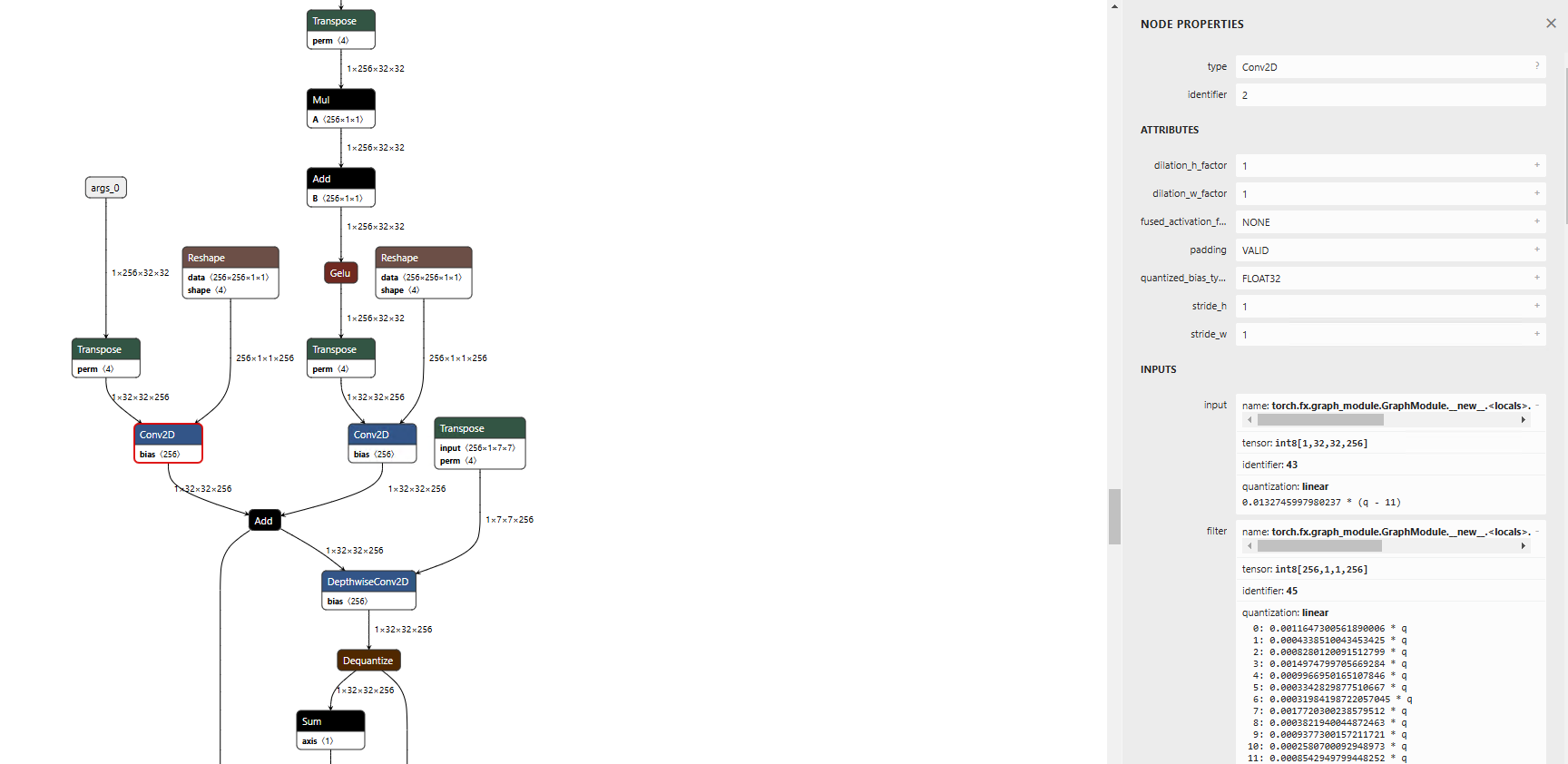
Usual export
After rewriting the quantization_annotation, the Conv will be output in Float.
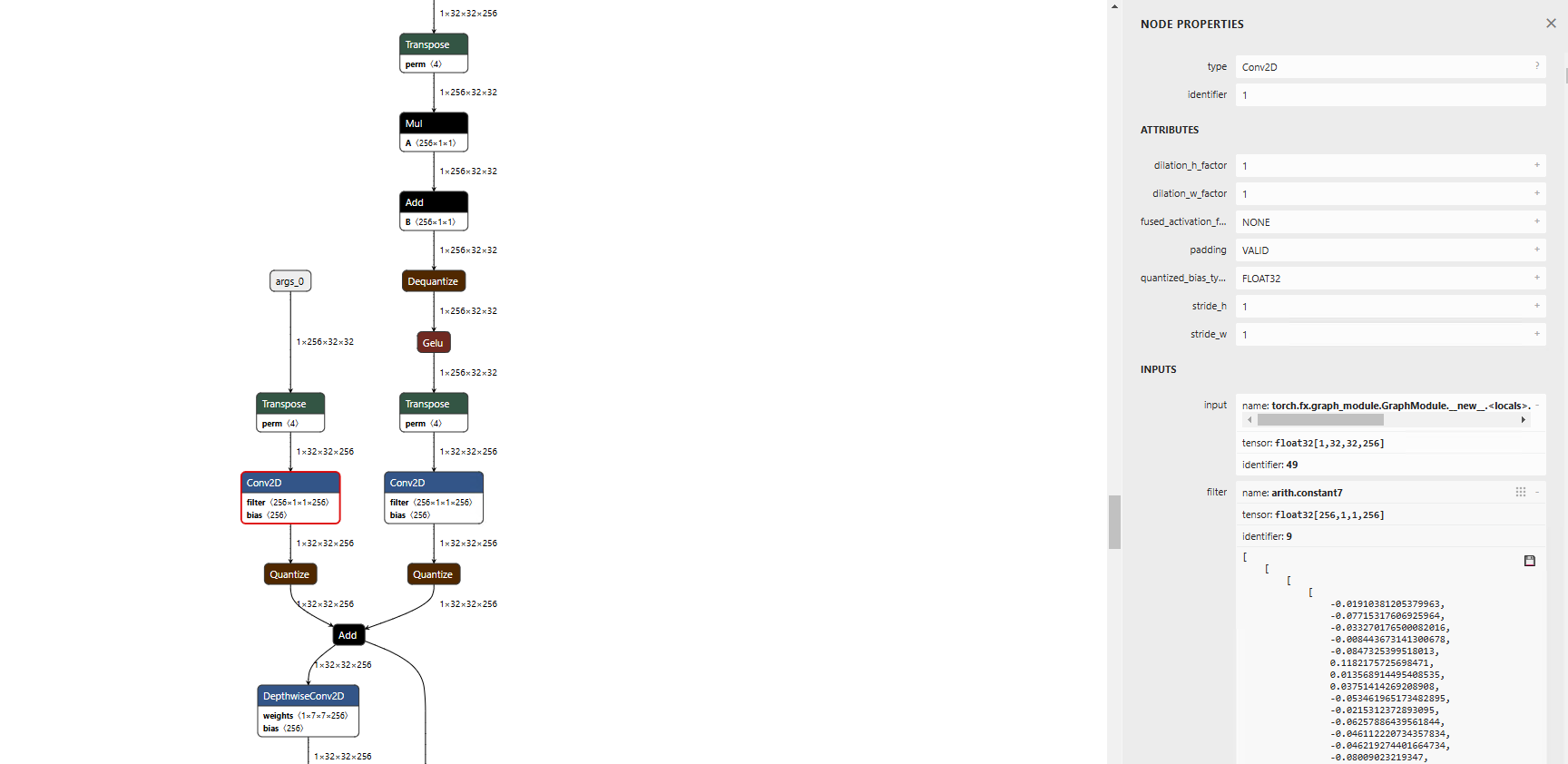
Export with Float annotation specified for Conv
In this example, the output_qspec remains as Int8 because the layer after Conv is expected to operate in Int8. However, if you want the subsequent layer to operate in Float, you can assign float_spec to output_qspec as well.
n.meta["quantization_annotation"].output_qspec = float_spec
Run TransposeConv in Int8
Since TransposeConv is not annotated in AI Edge Torch, it is processed in Float. If you want it to be processed in Int8, apply the annotation to the input of torch.ops.aten.conv_transpose2d.input.
import ai_edge_torch

from ai_edge_torch.quantize import pt2e_quantizer
from ai_edge_torch.quantize import quant_config
from torch.ao.quantization import quantize_pt2e

from ai_edge_torch.quantize.pt2e_quantizer_utils import get_input_act_qspec, get_weight_qspec, get_bias_qspec, get_output_act_qspec
from torch.ao.quantization.quantizer import QuantizationAnnotation

quantization_config = pt2e_quantizer.get_symmetric_quantization_config(is_dynamic=False, is_per_channel=False)

class PT2EQuantizer2(pt2e_quantizer.PT2EQuantizer):
    def annotate(self, model: torch.fx.GraphModule) -> torch.fx.GraphModule:
        super().annotate(model)

        for n in model.graph.nodes:
            if n.target in [torch.ops.aten.conv_transpose2d.input]:
                input_qspec_map = {}

                input_qspec_map[n.args[0]] = get_input_act_qspec(quantization_config)

                # weightにも制約をかけるとうまくint8に変換できなくなるため、inputにだけ制約をかける
                #input_qspec_map[n.args[1]] = get_weight_qspec(quantization_config)
                #input_qspec_map[n.args[2]] = get_bias_qspec(quantization_config)

                n.meta["quantization_annotation"] = QuantizationAnnotation(
                    input_qspec_map=input_qspec_map,
                    output_qspec=get_output_act_qspec(quantization_config),
                    _annotated=True,
                )

        return model

quantizer = PT2EQuantizer2().set_global(
    quantization_config
)
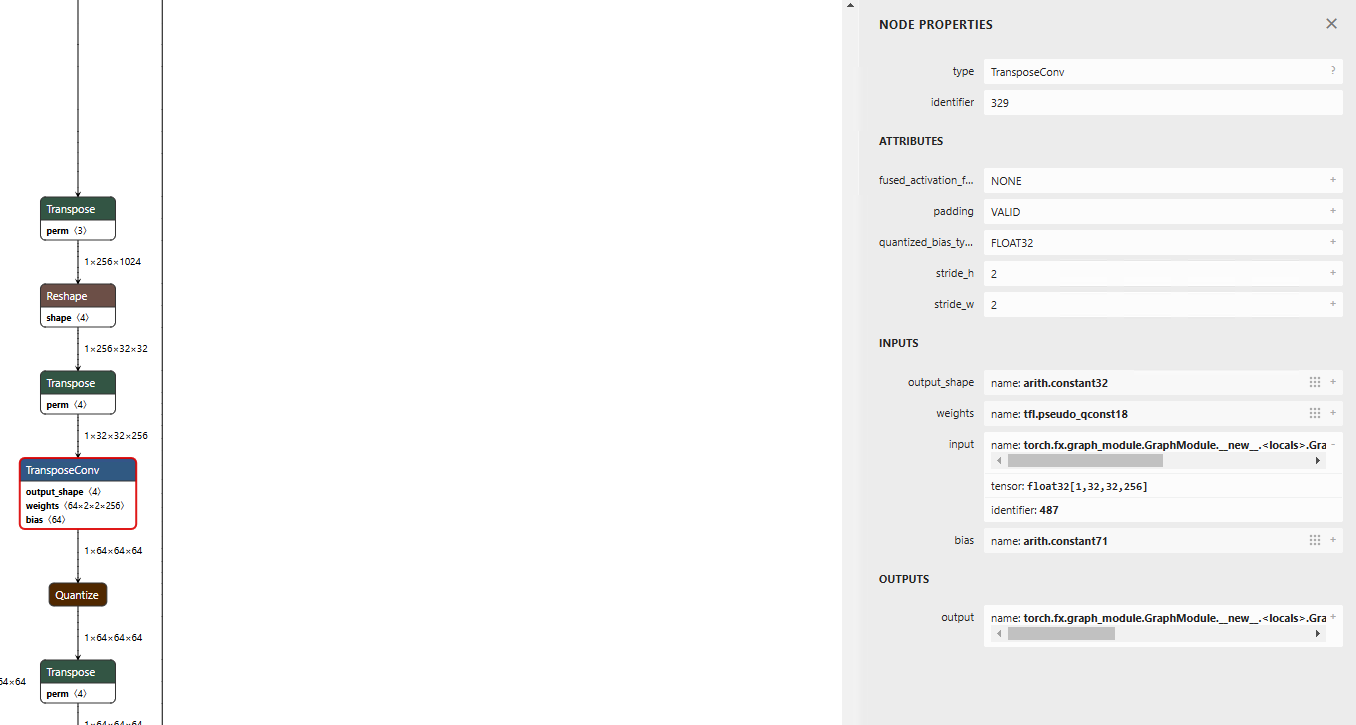
Normal export
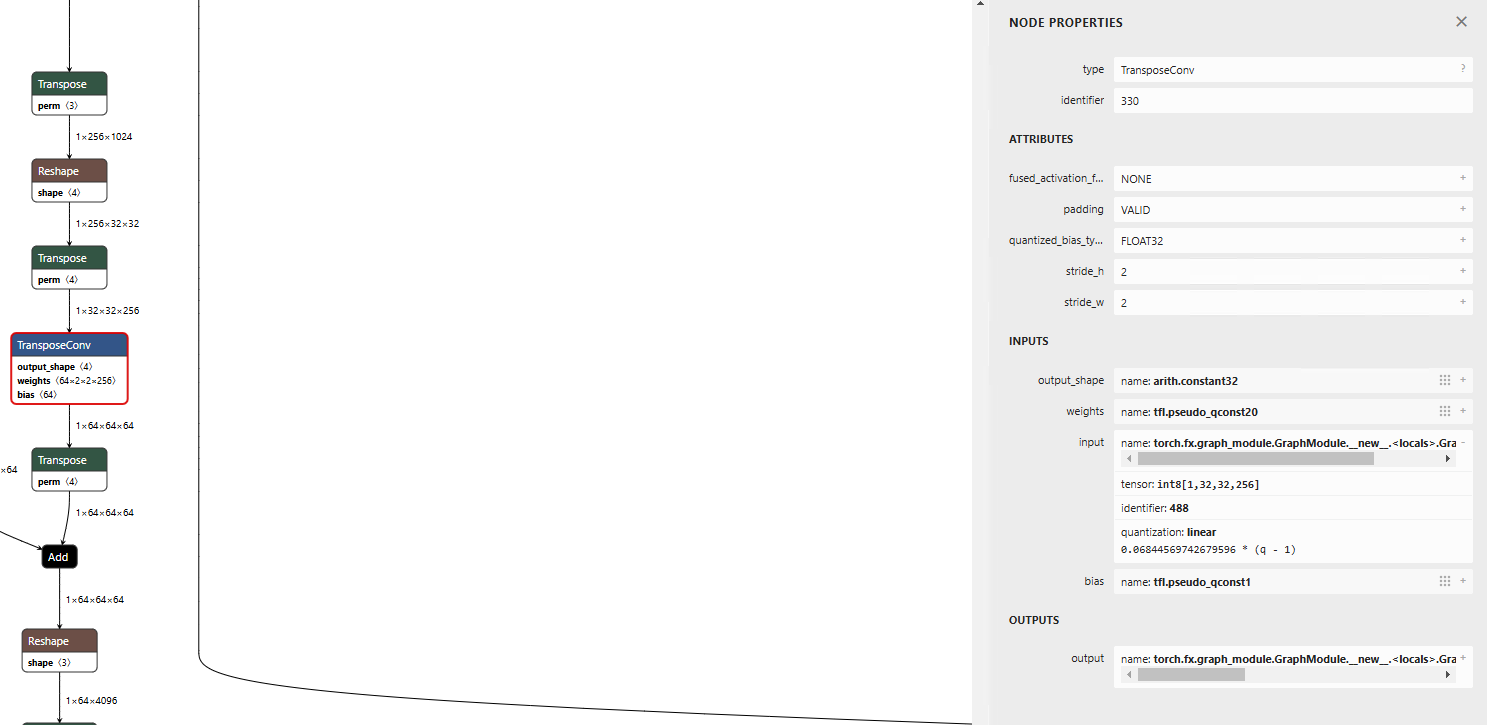
Export with Int8 annotation applied
Unify quantization parameters across multiple layers
To use the same quantization parameters across multiple layers, use SharedQuantizationSpec. Create a SharedQuantizationSpec from the source layer, and assign it to the output_qspec of the target layers. This allows quantization to be performed using a shared observer.
quantization_config = pt2e_quantizer.get_symmetric_quantization_config(is_dynamic=False, is_per_channel=True)

class PT2EQuantizer2(pt2e_quantizer.PT2EQuantizer):
    def annotate(self, model: torch.fx.GraphModule) -> torch.fx.GraphModule:
        super().annotate(model)

        target_node = None
        for n in model.graph.nodes:
            if str(n.target) == "output":
                target_node = n.args[0][0]

        for n in model.graph.nodes:
            if n == target_node:
                input_qspec_map = {}
                input_qspec_map[n.args[0]] = get_input_act_qspec(quantization_config)
                n.meta["quantization_annotation"] = QuantizationAnnotation(
                    input_qspec_map=input_qspec_map,
                    output_qspec=get_output_act_qspec(quantization_config),
                    _annotated=True,
                )

        return model
Make the model output in Int8
If the layer connected to the model’s output is not annotated, the model output will be in Float. To make the model output Int8, trace back to the input layer connected to the output and apply the appropriate annotation.
quantization_config = pt2e_quantizer.get_symmetric_quantization_config(is_dynamic=False, is_per_channel=True)

class PT2EQuantizer2(pt2e_quantizer.PT2EQuantizer):
    def annotate(self, model: torch.fx.GraphModule) -> torch.fx.GraphModule:
        super().annotate(model)

        target_node = None
        for n in model.graph.nodes:
            if str(n.target) == "output":
                target_node = n.args[0][0]

        for n in model.graph.nodes:
            if n == target_node:
                input_qspec_map = {}
                input_qspec_map[n.args[0]] = get_input_act_qspec(quantization_config)
                n.meta["quantization_annotation"] = QuantizationAnnotation(
                    input_qspec_map=input_qspec_map,
                    output_qspec=get_output_act_qspec(quantization_config),
                    _annotated=True,
                )

        return model
The args of a node in the FX graph are usually in the form of (input1, input2). However, for operators like output or aten.concat.default, they are stored in a special format: ([input1, input2], param). Therefore, instead of n.args[0], n.args[0][0] is used to reference the input node for the output.
Provide Int64 or Bool as the input tensor
If the model’s input tensor is of type Int64 or Bool, a dtype error may occur during quantization.
torch._dynamo.exc.TorchRuntimeError: Failed running call_function quantized_decomposed.quantize_per_tensor.default(*(FakeTensor(..., size=(1, 128), dtype=torch.bool), 0.003919653594493866, -128, -128, 127, torch.int8), **{}):
Expecting input to have dtype torch.float32, but got dtype: torch.bool
This happens because the input tensor is connected to an operator like concat that undergoes quantization, which leads to an attempt to quantize the input tensor. To avoid this issue, you need to disable quantization for the nodes connected to input tensors of types like Int64 or Bool.
To investigate which node is causing the issue, you can check the Exported Program or inspect the node information during annotation.
model = quantize_pt2e.convert_pt2e(model, fold_quantize=False)
print(model)
class PT2EQuantizer2(pt2e_quantizer.PT2EQuantizer):
    def __init__(self, quantization_config):
        super().__init__()
        self.quantization_config = quantization_config

    def annotate(self, model: torch.fx.GraphModule) -> torch.fx.GraphModule:
        super().annotate(model)

        for n in model.graph.nodes:
            print(n.target, n.name, n.args, "quantization_annotation" in n.meta)
Once the problematic node is identified, disable quantization for that node.
class PT2EQuantizer2(pt2e_quantizer.PT2EQuantizer):
    def __init__(self, quantization_config):
        super().__init__()
        self.quantization_config = quantization_config

    def annotate(self, model: torch.fx.GraphModule) -> torch.fx.GraphModule:
        super().annotate(model)

        for n in model.graph.nodes:
            if n.target in [torch.ops.aten.cat.default]:
                if "quantization_annotation" in n.meta:
                    if str(n.args[0][1]) == "arg5_1":
                        act_observer_or_fake_quant_ctr = PlaceholderObserver

                        float_spec = QuantizationSpec(dtype=torch.float32,
                            observer_or_fake_quant_ctr=act_observer_or_fake_quant_ctr.with_args(
                            eps=2**-12
                        ),)

                        for key in n.meta["quantization_annotation"].input_qspec_map:
                            n.meta["quantization_annotation"].input_qspec_map[key] = float_spec
Conclusion
We have introduced how AI Edge Torch performs quantization through a path from PyTorch’s dynamic graph, to the static FX graph, then to Exported Program, StableHLO, MLIR, and finally to TFLite.
It’s an extensive flow, but based on the principle that intermediate representations are transformed equivalently, we can understand that quantization accuracy depends primarily on the annotations and QuantizationSpecs applied to the static FX graph. By understanding this internal structure, we can see that there is room for deeper optimization.
ailia Inc. has developed ailia SDK, which enables cross-platform, GPU-based rapid inference.
ailia Inc. provides a wide range of services from consulting and model creation, to the development of AI-based applications and SDKs. Feel free to contact us for any inquiry.