 ailia Tech BLOG
KVCache: Speed Up Processing by Caching the Results of Attention Calculations
KVCache is a technique that accelerates Transformers by caching the results of Attention calculations.
In language models using Transformers, the output token from the current inference is concatenated with the input tokens and reused as the input tokens for the next inference. Therefore, in the (N+1)th inference, the N tokens are exactly the same as in the previous inference, with only one new token added.
KVCache stores the reusable computation results from the current inference and loads them for use in the next inference. As a result, unlike typical caches, cache misses do not occur.
Standard Attention
In Attention, the output is computed by multiplying Query (Q) and Key (K) to obtain QK, applying Softmax, and then performing a matrix multiplication with Value (V). When decoding N tokens has been completed and the (N+1)th token is inferred, the column size of the QK matrix becomes (N+1). As a result, the processing time increases as decoding progresses.
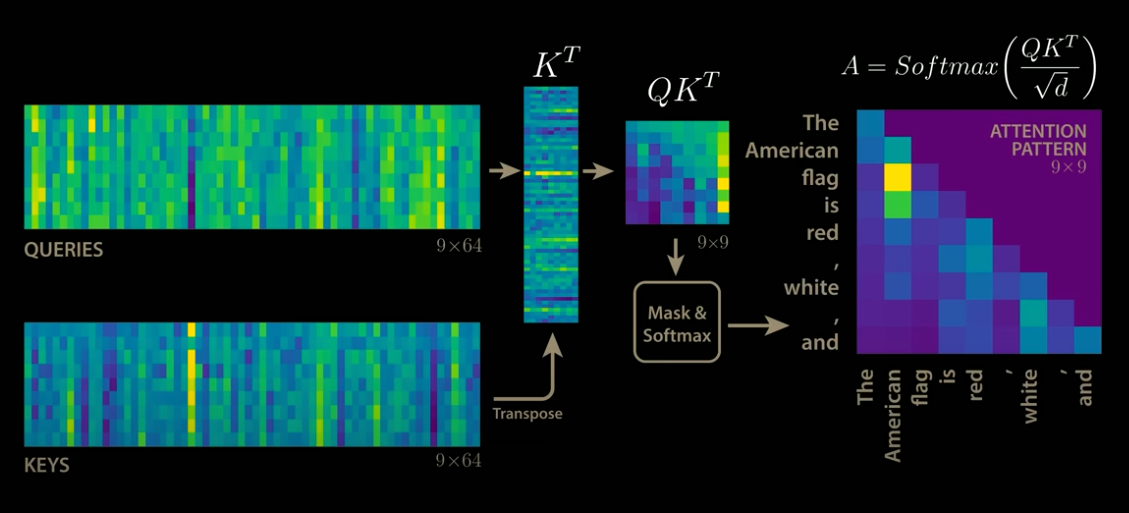
Standard Attention (Source: https://www.youtube.com/watch?app=desktop&v=0VLAoVGf_74)
Attention with KVCache
When using KVCache, the result of the previous Q and K matrix multiplication is cached in VRAM, and only the matrix multiplication for the newly added token is computed. This result is then integrated with the previously cached result. As a result, only the newly added token needs to be processed, leading to faster performance
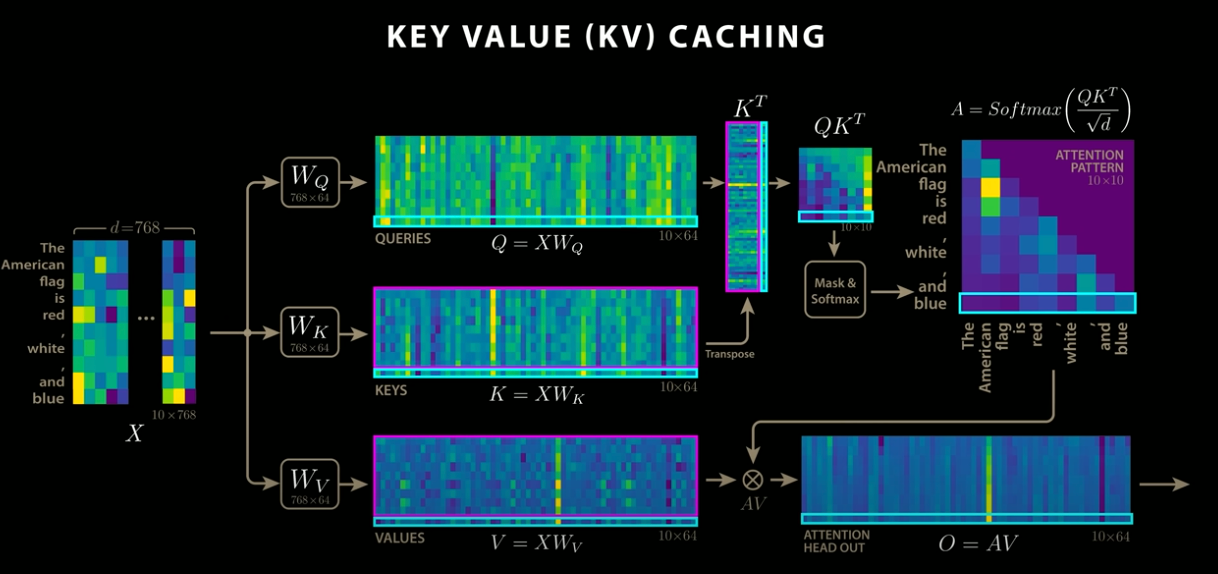
KVCache implementation (Source: https://www.youtube.com/watch?app=desktop&v=0VLAoVGf_74)
When a new token is added to Q and K, it may seem that not only the bottom row but also the rightmost column of QK would change. However, in Transformers, future tokens are masked to prevent them from being referenced, so only the bottom row of QK is updated. As a result, only the bottom row of QKV is also updated, and KVCache functions correctly even when multiple Attention layers are stacked.
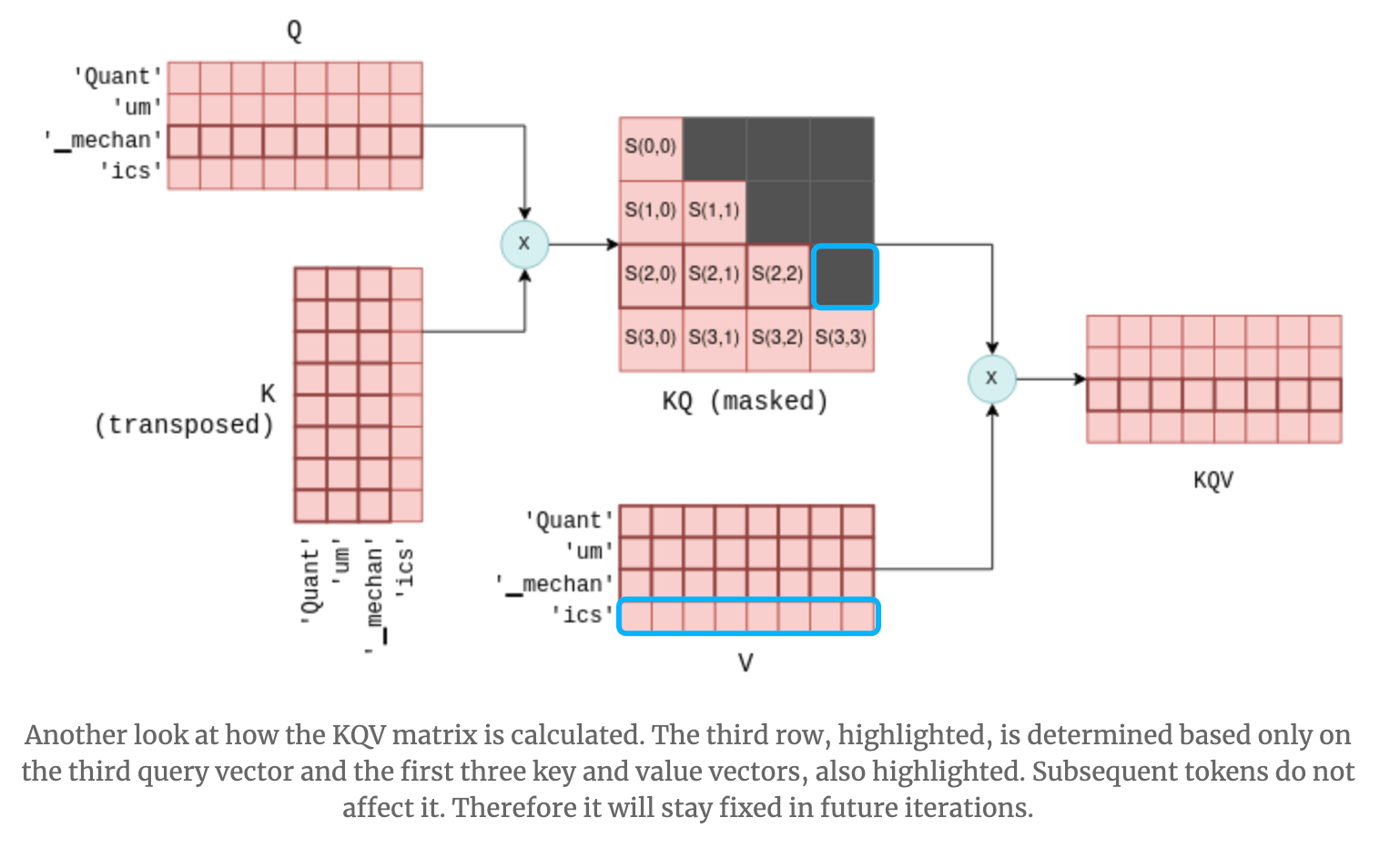
KQ masking (Source: https://blog.csdn.net/taoqick/article/details/137476233)
KVCache performance
Without KVCache, the processing time increases non-linearly with the length of the input tokens. By using KVCache, the processing time can be made linear with respect to the number of input tokens.
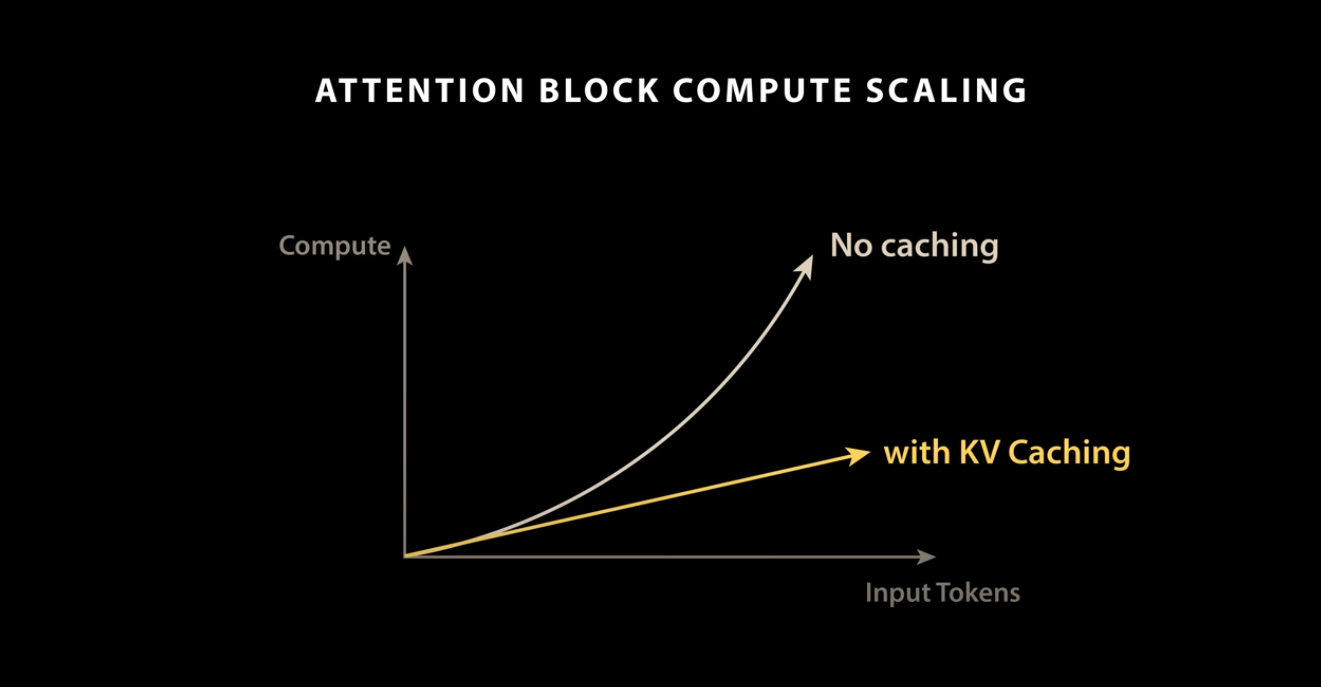
Source: https://www.youtube.com/watch?app=desktop&v=0VLAoVGf_74
Other applications of KVCache
In addition to accelerating Transformer decoding, KVCache is also used for prompt caching in LLMs. Prompt caching enables fast execution of multiple different questions on the same context by storing and reusing the KVCache.
Moreover, as a variation of RAG, a method called CAG (Cache-Augmented Generation) has been proposed. It speeds up RAG by caching entire context documents into KVCache.
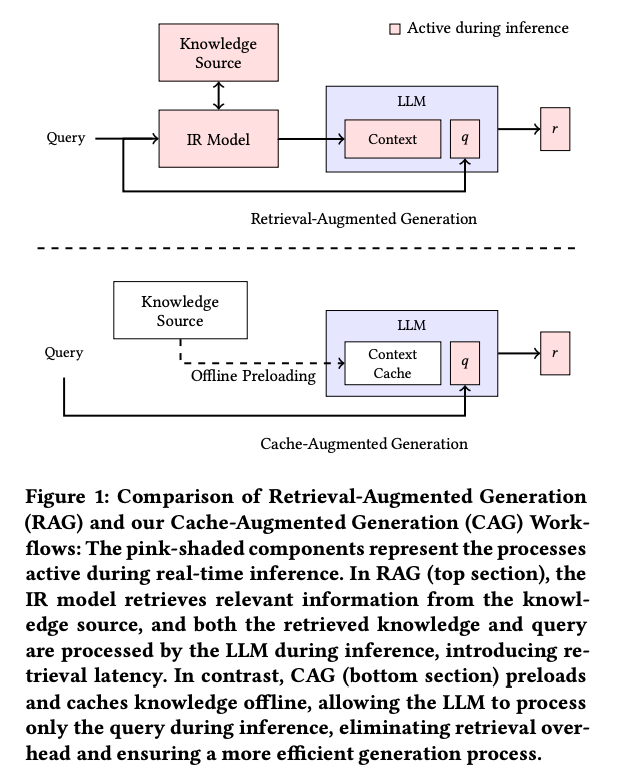
Source: https://arxiv.org/pdf/2412.15605
Challenges of KVCache
KVCache stores the results of matrix multiplications in VRAM, which leads to a significant increase in VRAM usage. To address this issue, DeepSeek has introduced a technique that compresses the KVCache.
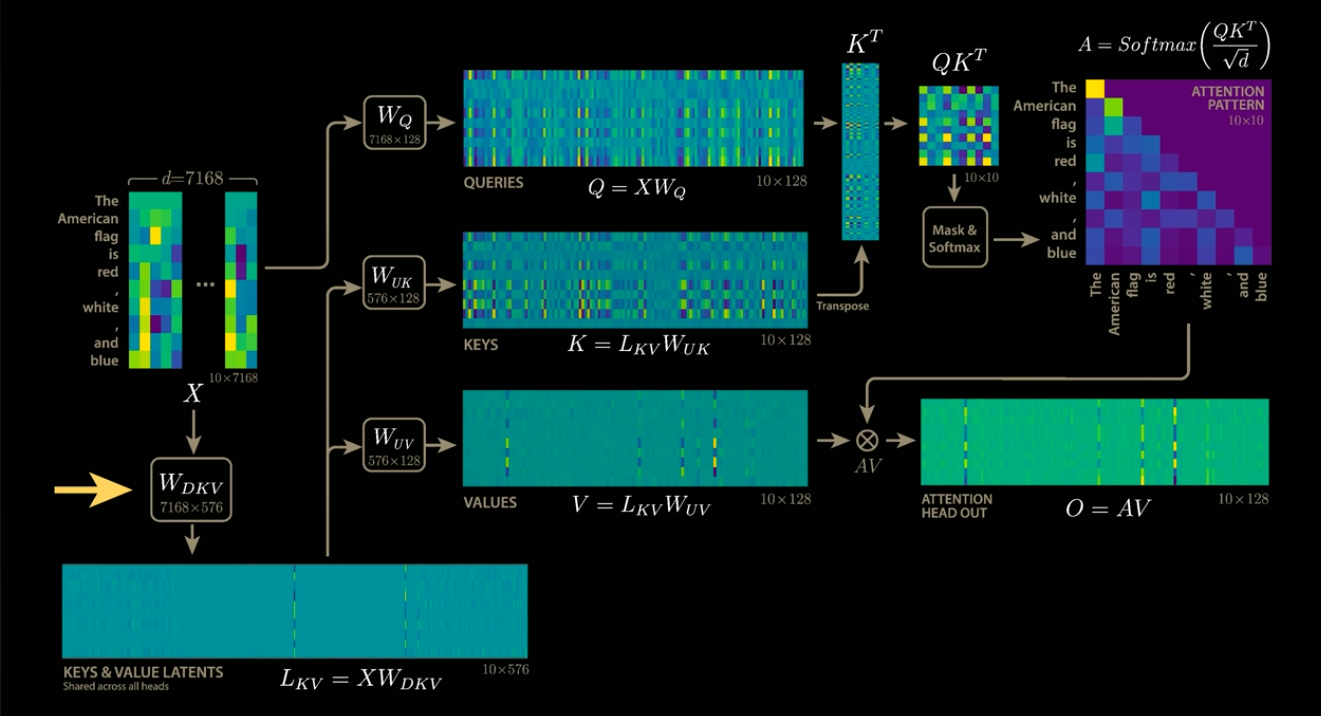
KVCache compression (Source: https://www.youtube.com/watch?app=desktop&v=0VLAoVGf_74)
KVCache optimization in DeepSeek
ailia Inc. has developed ailia SDK, which enables cross-platform, GPU-based rapid inference.
ailia Inc. provides a wide range of services from consulting and model creation, to the development of AI-based applications and SDKs. Feel free to contact us for any inquiry.