 ailia Tech BLOG
Gaze-LLE: Gaze Estimation Model Trained on Large-Scale Data
This is an introduction to「Gaze-LLE」, a machine learning model that can be used with ailia SDK. You can easily use this model to create AI applications using ailia SDK as well as many other ready-to-use ailia MODELS.
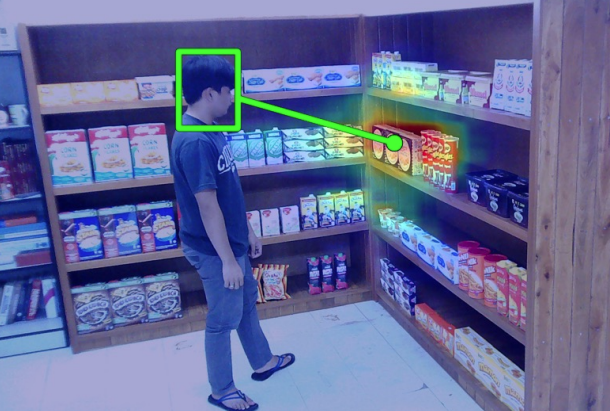
Overview
Gaze-LLE is a gaze estimation model released in December 2024 by the Georgia Institute of Technology and the University of Illinois. It provides four pretrained models. All models take an image and the bounding box of the subject’s head as input. The vitb14 and vitl14 models output a heatmap of the gaze target, while the vitb14_inout and vitl14_inout models additionally estimate the probability that the gaze target is within the image.
Main characteristics
Traditional gaze estimation methods often employed complex architectures combining multiple modules such as scene encoders, head encoders, depth estimation, and pose estimation. However, these approaches posed challenges such as difficulty in training and slow model convergence.
Gaze-LLE addresses these issues by using a large-scale foundation model as the encoder and constructing a lightweight decoder. This design significantly simplifies the architecture compared to conventional methods and dramatically improves training efficiency.
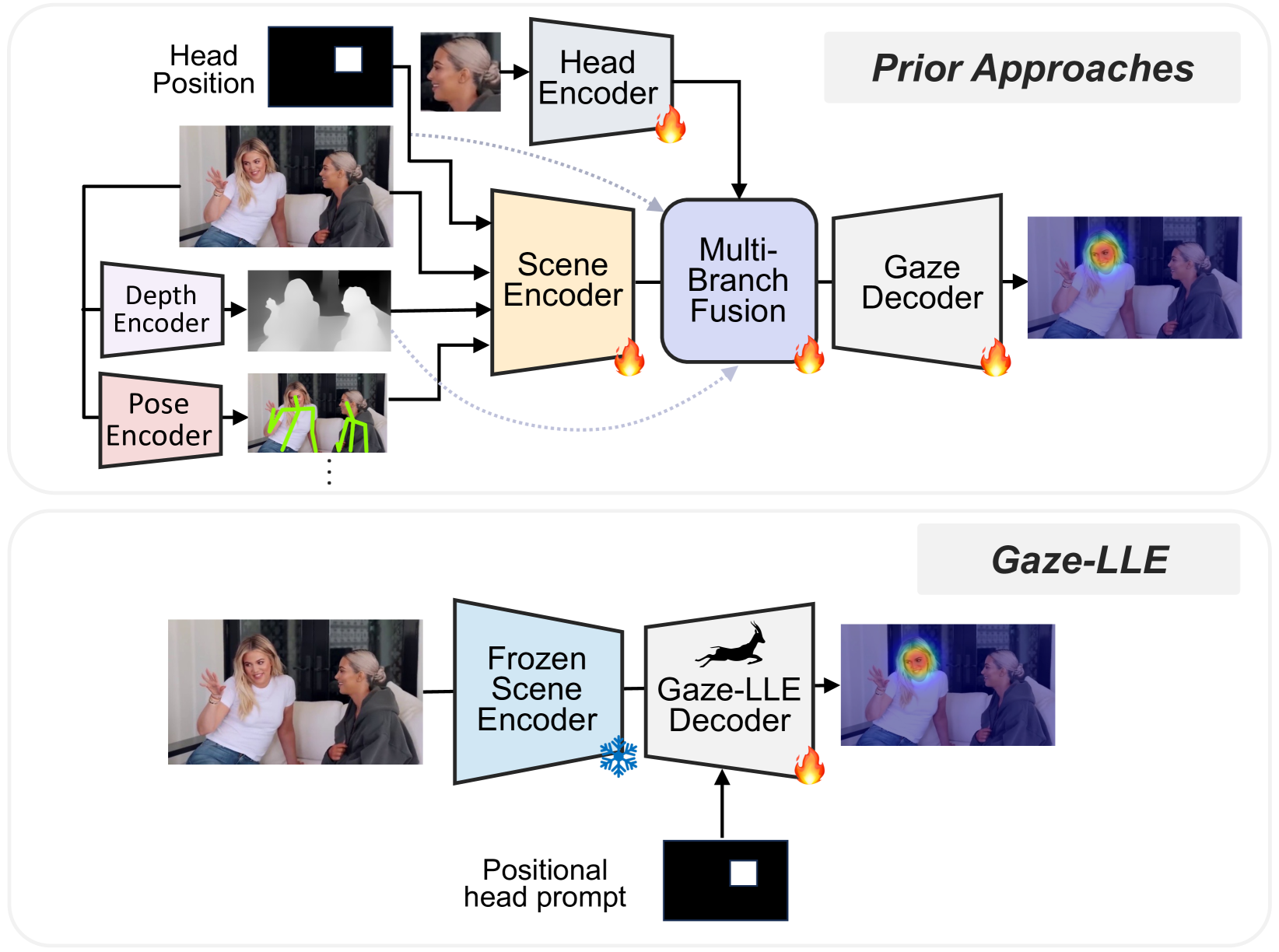
Conventional approaches vs. Gaze-LLE (Source: https://arxiv.org/abs/2412.09586)
Architecture
Gaze-LLE performs gaze estimation through the following steps:
First, the input image is passed through a frozen encoder (primarily DINOv2) to extract image features. Then, a binary mask generated from the head bounding box is used to add position embeddings to the extracted features. This process produces a feature map focused on the specific person’s head and is referred to as “Head Prompting.”
The resulting image feature map is updated through three Transformer layers. After that, an upsampling operation is performed, and the features are decoded into a gaze target heatmap.
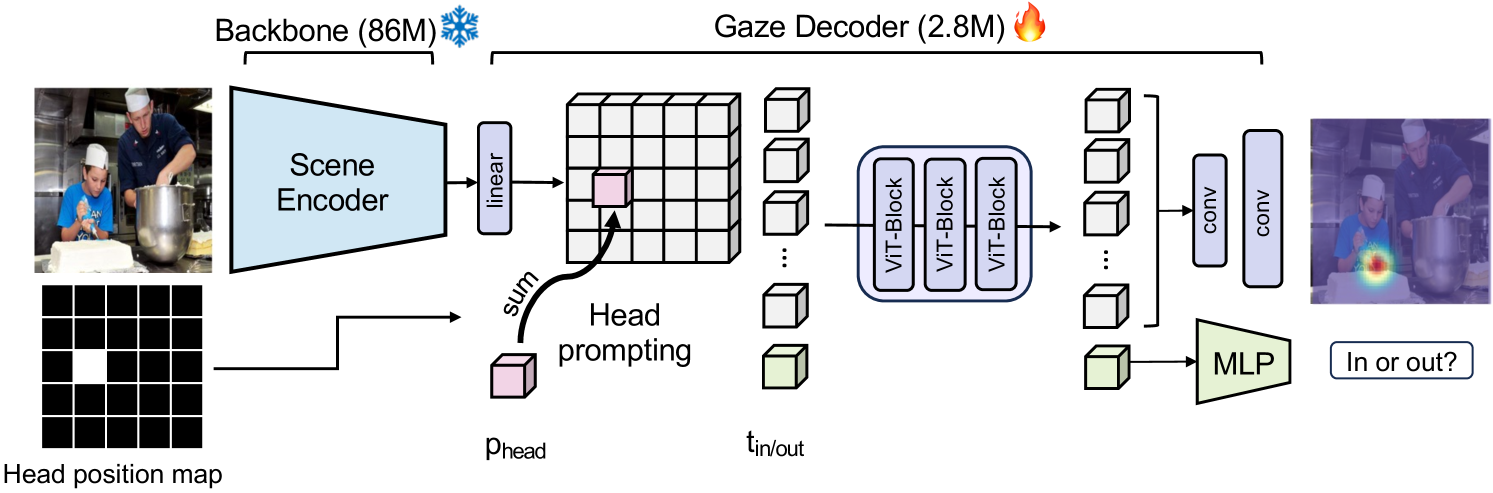
Gaze-LLE architecture (Source: https://arxiv.org/abs/2412.09586)
Gaze-LLE adopts a design in which the head bounding box is incorporated after the scene encoder. This approach significantly improves performance compared to conventional methods that combine the bounding box with the input image before feeding it into the scene encoder.
Performance
Gaze-LLE demonstrated strong performance on both the GazeFollow and VideoAttentionTarget datasets. Notably, despite having one to two orders of magnitude fewer trainable parameters compared to previous studies, it achieved state-of-the-art or near state-of-the-art results on key evaluation metrics.
These results demonstrate that Gaze-LLE enables lightweight yet highly accurate gaze estimation.
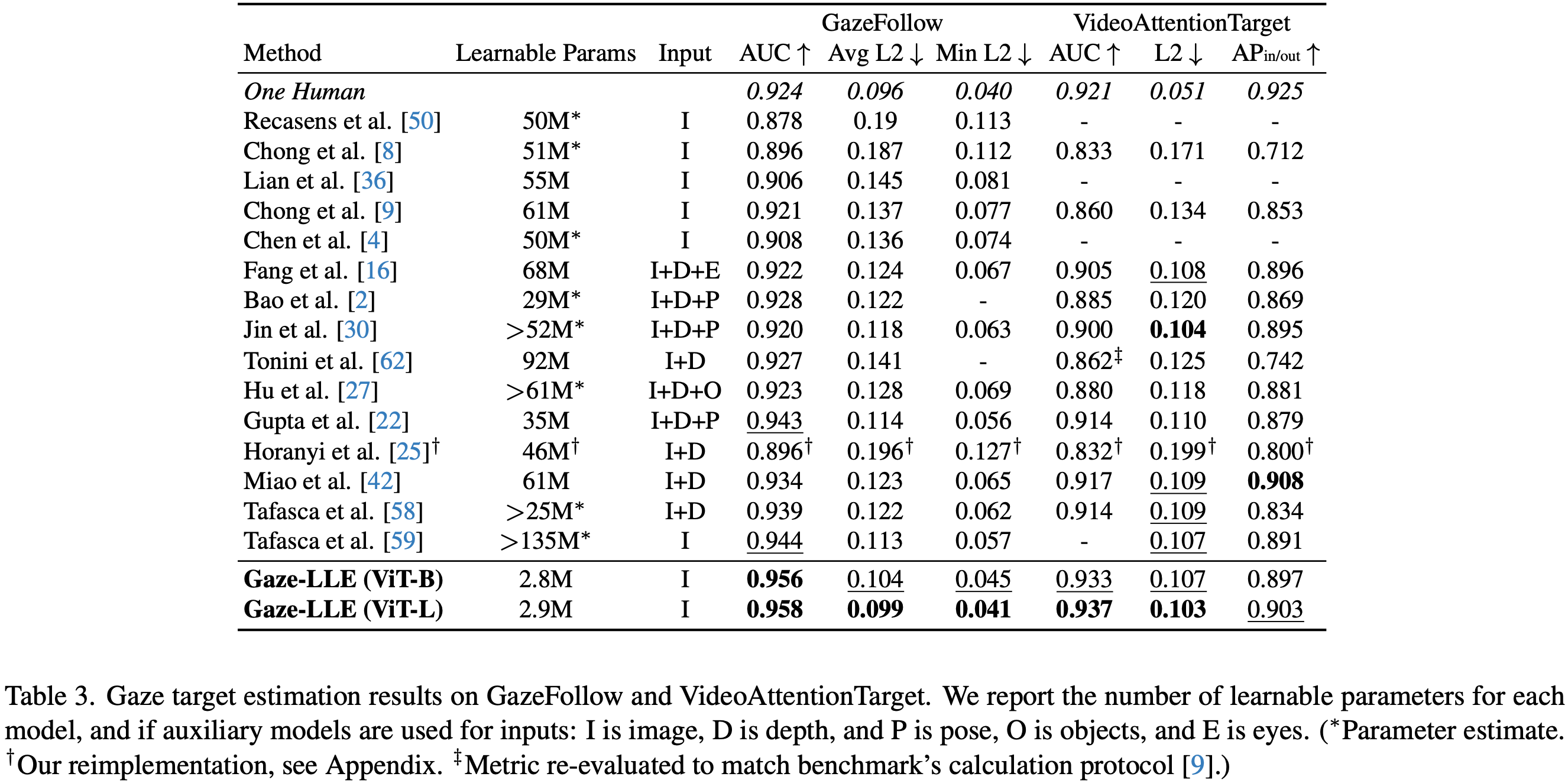
Gaze-LLE benchmark (Source: https://arxiv.org/abs/2412.09586)
Reliance on foundation models
Gaze-LLE primarily uses DINOv2, but it is also compatible with other foundation models. The table below shows the performance when using different pretrained models. Among them, DINOv2 achieved the highest accuracy as a state-of-the-art feature extraction encoder. CLIPalso demonstrated strong performance. Furthermore, as more advanced foundation models are developed in the future, it is expected that the accuracy of gaze estimation using Gaze-LLE will further improve.
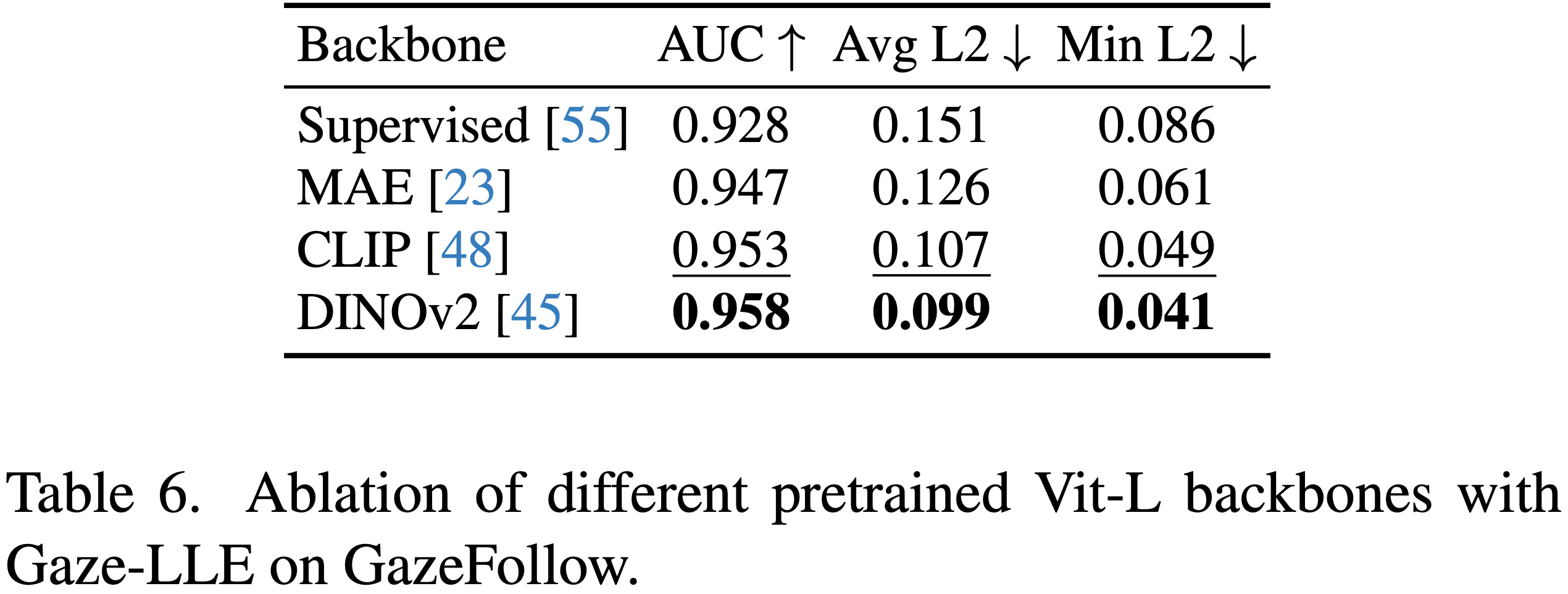
Source: https://arxiv.org/abs/2412.09586
Effectiveness of “Head Prompting”
To verify the effectiveness of Head Prompting in Gaze-LLE, inference was performed using a model without Head Prompting, and the results were compared.
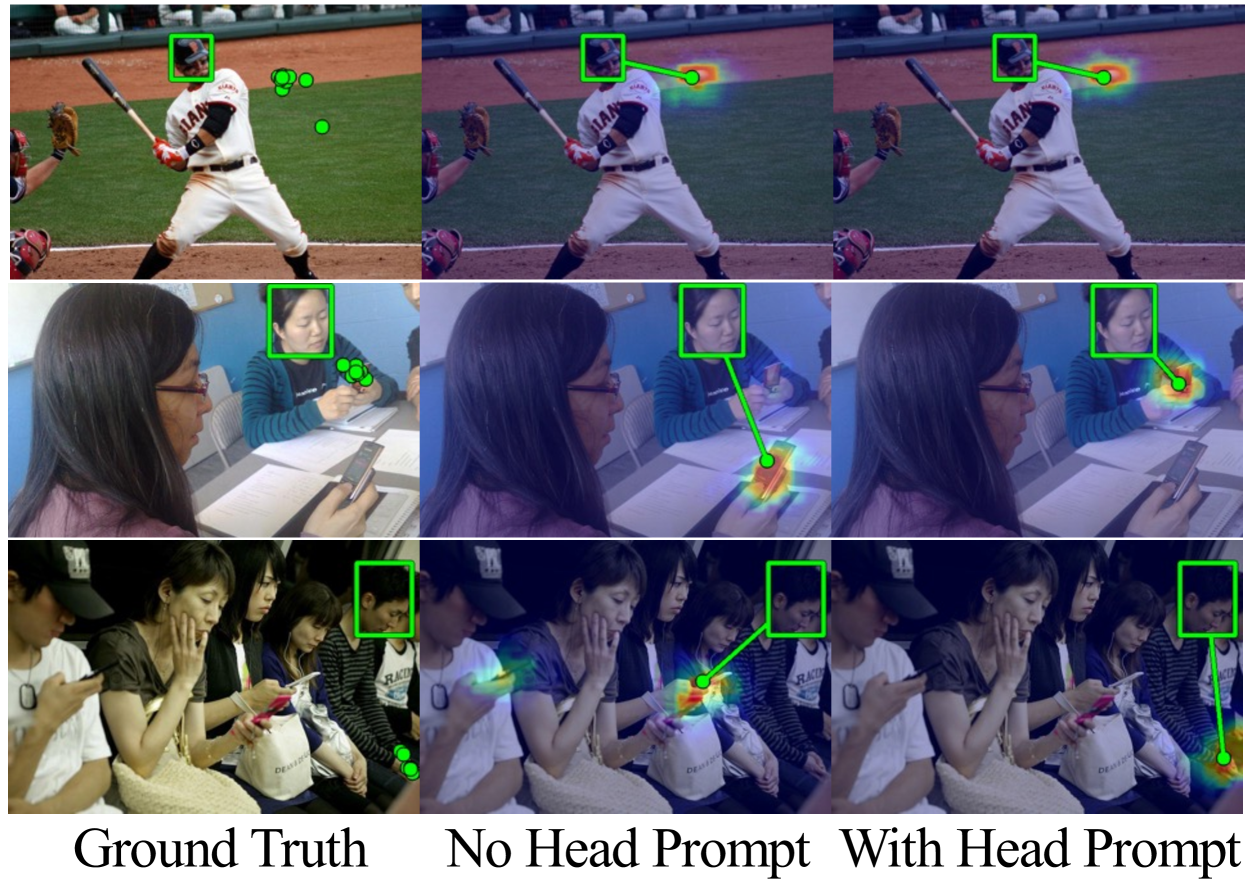
Benchmark (Source: https://arxiv.org/abs/2412.09586)
As shown in the first row, when there is only one person in the image, accurate gaze estimation was achieved even without Head Prompting. This suggests that the encoder is already capable of detecting the head within the image and leveraging that information.
On the other hand, as seen in the second and third rows, when multiple people are present in the image, the model was observed to estimate the gaze of the wrong individual. This indicates that Head Prompting plays a crucial role in explicitly informing the model whose information should be used for gaze estimation.
Usage
To use Gaze-LLE with ailia SDK, use the command below. By default, the pretrained model vitl14_inout is used.
python3 gazelle.py --input input.png --savepath output.png
To display the gaze estimation results as a heatmap, add the heatmap option.
python3 gazelle.py --input input.png --headmap
ailia Inc. has developed ailia SDK, which enables cross-platform, GPU-based rapid inference.
ailia Inc. provides a wide range of services from consulting and model creation, to the development of AI-based applications and SDKs. Feel free to contact us for any inquiry.